

By Alphonsus Okoroigwe
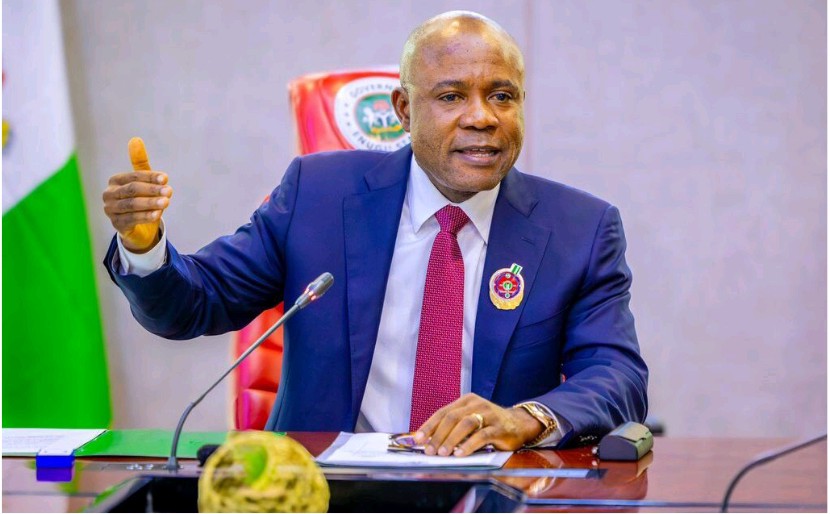
There are governors who manage a state, and there are governors who remake a state. Considering the shape of things in Enugu today, many would admit that Dr. Peter Mbah has firmly kept himself in the second category, three years and counting.
In his inaugural speech on May 29, 2023, he promised what many considered as too ambitious: to grow Enugu’s economy from $4.4 billion to $30 billion in eight years, to eradicate poverty, and to make Enugu the preferred destination for investment, business, tourism, and living in Nigeria. That perceived rhetoric has given way to verifiable reality, with observers acknowledging the increasing scale of transformation.
Little wonder Phillips Consulting ranked Enugu as the fastest improving state in its 2026 State Performance Momentum Index. Little wonder also Governor Mbah was honoured with the International Good Governance Award in Virginia, United States in September 2025 for redefining governance. The facts on the ground are numerous, speaking louder than any political endorsement.
Perhaps the boldest statement Mbah has made is in education. For three consecutive fiscal years – 2024, 2025, and 2026 – he has allocated over 33 percent of the state’s entire budget to education, surpassing the UNESCO recommendation. No other state in Nigeria has done that in this Fourth Republic, arguably.
The money for education is not just budgeted but also visible, as the administration is building 260 Smart Green Schools – one in each of the state’s 260 electoral wards. These are not those dilapidated classroom blocks people used to know. Everything is totally different. Each Smart Green School is equipped with interactive digital whiteboards, science laboratories, robotics and artificial intelligence studios, ICT centres, and solar-powered water and electricity.
According to official records, over 7,000 new classrooms have been constructed by the Mbah administration across Enugu State. With over 6,500 Smart School teachers to be recruited and more than half of this figure recruited so far, it has mandated 12 years of free, compulsory, and qualitative education – from Primary 1 to Senior Secondary 3. And just recently, it flagged off its Experiential Learning Model in partnership with global education institutions, positioning Enugu children to compete with their peers in Finland and Singapore, not just in Nigeria.
Adopting the same ward-based development model in healthcare, the Mbah administration is building 260 Type II hospitals and solar-powered primary healthcare centres, one in each electoral ward. It also approved the recruitment of 2,250 health personnel – including doctors, nurses, midwives, pharmacists, and community health extension workers – to run the facilities.
More so, it is positioning the Enugu State International Hospital as a medical tourism hub to reverse capital flight. At the Enugu State University Teaching Hospital, Parklane, it is constructing a new Accident and Emergency Department, seven-floor Nursing Complex, and twin six-floor clinical and laboratory blocks; and installing modern surgical equipment, ventilators, neurosurgical theatre tables, and capnography-fitted anaesthetic gear. Also, it renovated and re-equipped the Neonatal and Special Babies Ward at the same teaching hospital, facilitating postgraduate accreditations from the West African College of Surgeons and the National Postgraduate Medical College of Nigeria, and training 1,000 health workers.
Assuming office in May 2023, Mbah’s reforms pushed the state’s Internally Generated Revenue (IGR) up to N37.4 billion (comprising N22.9 billion in tax revenue and N14.5 billion in non-tax revenue) for that fiscal year. It jumped to N180.5 billion in 2024, and by the end of 2025, revenue sources confirmed Enugu’s IGR at N406.77 billion – representing a 125 percent growth year-over-year.
The Mbah administration has been strategic about this growth. Contrary to the allegation of multiple taxation, 87.4 percent of the state’s revenue came from non-tax activities such as reviving, monetising, and commercialising previously untapped or abandoned state-owned resources and assets.
Thinking outside the box, the government under Mbah revived and commercialised assets that had been moribund for over twenty years – including United Palm Products Limited with 6,700 hectares of palm plantation, Sunrise Flour Mill, Hotel Presidential, Nigergas Company, and the International Conference Centre. It secured a $100 million foreign direct investment (FDI) deal with Austrian firm, OSTAP International Water Consulting to modernise and boost the state’s water infrastructure, and commissioned a $20 million Haier high-tech factory in Enugu for laptops, smartphones, smart boards, tablets, solar tricycles, renewable energy solutions, and spare parts.
The government has also constructed and reconstructed strategic roads, currently working on over 1,000 kilometres of urban, rural, and intercity roads. From the dualisation of the Abakpa Nike-Opi-Nsukka Road connecting Enugu metropolis to the university town of Nsukka, to the reconstruction of gateway roads such as the Nike Lake Road and the roads inside the New Enugu Smart City, the administration is redefining critical infrastructure.
With the launch of state-owned airline, Enugu Air, construction of five ultra-modern transport terminals at Holy Ghost, Garki, Abakpa, and Nsukka, and purchase of over 200 Compressed Natural Gas (CNG) buses, and the 042 Ride Taxi Scheme, the administration has broken new ground that is not just generating huge revenue but also enhancing the state’s prospects in aviation and transport.
In January 2026, Governor Mbah announced a 60 percent reduction in the cost of processing Certificates of Occupancy (C of O), unification of land charges, and most importantly, the abolition of all activities of non-state actors locally known as ‘Ogbonecheagu’ who hitherto used arbitrary levies to extort developers. Land processing now takes weeks, against an old, corrupt tradition that used to take years. Perhaps this is why real estate investment is booming in Enugu.
The construction of a world-class Command and Control Centre with 24/7 surveillance using AI-powered CCTV cameras across the metropolis is another landmark achievement of the Mbah administration. With drone patrols, a DNA forensic laboratory, and a Distress Response Squad (DRS), he is making Enugu State one of the safest states in Nigeria – a prerequisite for investment.
Indications abound that Governor Mbah is not building for today, but for the next 50 years. His achievements this first term loudly speak ahead of an Enugu State where people will have equal opportunities; where children will have access to the same quality of digital education and modern healthcare.
Having journeyed this far, the question is no longer whether Peter Mbah is working well. The question before Ndi Enugu now is how to protect and sustain this disruptive model, as we approach 2027, so that Enugu does not return to the era of poverty and underdevelopment.
The target of growing Enugu to a $30 billion economy is succeeding by the governor’s scorecard as a work in progress. And this tempo should be consolidated by a second tenure because Mbah’s good turn deserves another.
Alphonsus Okoroigwe is an international multimedia journalist based in Enugu
