
Financial Illiteracy Deepens Economic Hardship In Nigeria, Says Financial Consultant

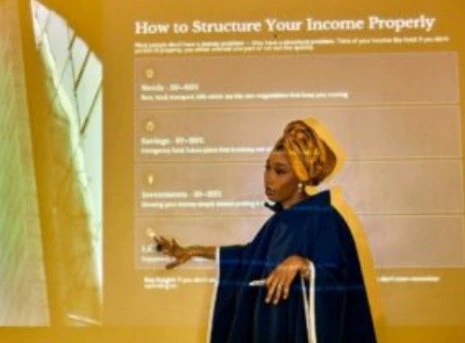
Financial illiteracy is worsening the economic difficulties confronting many Nigerians by leaving individuals and families poorly equipped to manage inflation, unemployment, rising living costs and unexpected financial emergencies.
This was the key message at Jawdi Stack Workshop, a financial literacy training organised by Jawdi Ltd in Abuja.
The convener and founder of Jawdi Ltd, Fatima Sanusi, said financial illiteracy was not simply a problem of inadequate income but also a lack of knowledge, skills and confidence needed to make informed decisions about earning, spending, saving, borrowing and investing.
Sanusi, a finance, portfolio management consultant and educator, said the consequences were particularly severe for low- and middle-income households with limited financial reserves.
She explained that a salaried worker without a budget, emergency savings or clearly defined financial goals could easily become trapped in a cycle of borrowing whenever unexpected expenses arose.
“Before the next salary arrives, unexpected expenses force them to borrow. They then spend the following month repaying the debt, only to borrow again when another emergency arises. Over time, this becomes a cycle that is difficult to break,” she said.
Sanusi said such circumstances should not necessarily be interpreted as financial irresponsibility, noting that many people had simply never received practical education on how to manage money.
She therefore called for financial literacy to be treated as an essential life skill rather than something reserved for wealthy people.
According to her, one of the major consequences of poor financial literacy is weak financial decision-making, stressing that earning more money does not automatically translate into financial security.
She said salary increases could quickly disappear through lifestyle inflation when individuals increased their spending without improving their savings, investments or long-term financial plans.
“Without basic financial knowledge, a salary increase can quickly disappear into lifestyle inflation,” she said.
The consultant also cautioned Nigerians against taking loans without understanding their repayment obligations, investing solely on the recommendations of friends or committing their savings to schemes that promise unusually high returns.
She noted that although Nigeria’s expanding digital economy had made financial information more accessible, access to information did not necessarily amount to financial literacy.
According to her, social media platforms are increasingly saturated with investment advice, money-making opportunities and financial influencers, leaving people with enormous amounts of information but not always the understanding required to make sound decisions.
“A person may know that mutual funds, stocks, bonds or other investment products exist without understanding which one is suitable for their financial goals, risk tolerance, investment horizon or circumstances,” she said.
Sanusi expressed concern that investment scams could thrive in an environment where financial knowledge is limited and people are desperate to grow their money quickly.
She urged Nigerians to ask important questions before committing funds to any investment opportunity, including who regulates it, how returns are generated, the risks involved, how easily funds can be accessed and what happens if the investment fails.
“These questions may sound simple, but asking them can make the difference between making an informed decision and suffering a preventable financial loss,” she said.
The founder said the impact of financial illiteracy extended beyond individuals, noting that financially vulnerable households were more likely to experience severe consequences when confronted with medical emergencies, job losses, business failures or other economic shocks.
She said such financial pressures could affect children’s education, housing, healthcare and the general wellbeing of families.
Sanusi called for greater attention to women and young people, particularly as many young Nigerians enter the workforce with professional skills but limited knowledge of budgeting, emergency savings, debt management, investment and retirement planning.
She also advocated practical financial education for women who earn incomes, operate businesses and contribute substantially to household finances, saying such knowledge would strengthen their ability to make informed financial decisions.
However, she cautioned that financial education should go beyond simply telling people to “save more” or “invest more.”
Instead, she called for practical financial education tailored to the realities of everyday Nigerian life.
Sanusi advocated the introduction of financial literacy at an early stage in schools, where young people could learn budgeting, saving, responsible borrowing, investing, risk management and financial planning before they begin earning substantial incomes.
She also urged employers to introduce financial education programmes for workers, while community organisations, women’s groups, religious institutions and professional associations could provide platforms for accessible financial education.
Financial institutions and investment professionals, she said, also had a responsibility to communicate financial products and risks in simple language that ordinary consumers could understand.
She stressed that it was not enough for financial products to be available, as consumers must understand what they were purchasing, their obligations and the risks involved.
Sanusi also urged Nigerians to discard the perception that financial education was only necessary for people with substantial wealth.
“We should stop assuming that someone must have a lot of money before they need to learn how to manage it,” she said.
“In reality, the less money someone has, the more important it may be that they understand how to protect and use it wisely.”
She acknowledged that financial literacy alone could not eliminate poverty, inflation or unemployment but maintained that it could equip individuals and families with better tools to navigate economic challenges.
According to her, Nigeria needs not only people who earn more but also citizens who understand how to manage and protect what they earn.
“Financial security is not built by income alone. It is built by informed decisions, consistent habits, appropriate financial products and the ability to distinguish opportunity from risk,” she said.
Sanusi therefore called for a coordinated national approach involving schools, employers, financial institutions, government agencies, community organisations and professional bodies to make financial education practical, accessible and understandable.
“The question, therefore, is no longer whether Nigerians need financial education. The question is how quickly we can make it practical, accessible and understandable enough for everyone to use,” she said.
COURTESY: Leadership
