

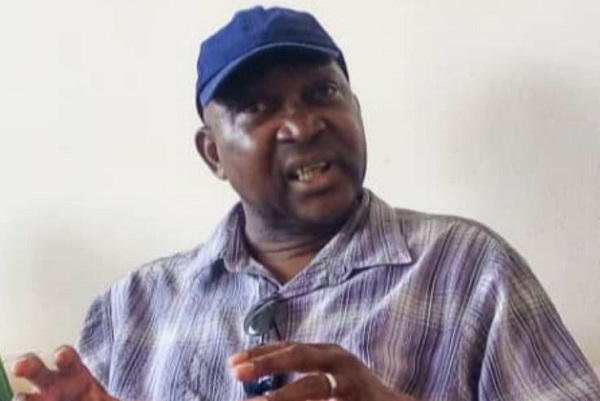
Former Flying Eagles captain Andrew Uwe has not left Nigerian football behind, even after three decades abroad. Now head coach of German club BV Essen, the 6ft-plus defender who once marshaled Nigeria’s backline in the 1980s and 1990s is looking back at where it all started, and forward at how to fix what he calls a broken development pathway.
In a wide-ranging interview with TAIWO ALIMI from his base in Germany, Uwe spoke about his childhood love for the game, his glory years in green and white, a journeyman career across Europe, and why he believes Nigeria’s slide can be reversed if we stop chasing shortcuts and build proper youth leagues.
His message comes at a time when President Bola Tinubu has directed a comprehensive reform of Nigerian football, with focus on governance, administration and accountability. For Uwe, reform must also answer one basic question: are qualified Nigerians at home and abroad being given a fair chance to serve?
Ibadan Roots: “My Parents Didn’t Want Me to Play, But Football Chose Me”.
Uwe’s story begins on the dusty fields of Ibadan, not in an academy.
“Yes I did find football because I was eager to play football,” he recalled. “My parents did not want their kid to play football, but I was deep and in love with football. They tried to stop me but along the line they did not have a choice but to be on my football side.”
That determination earned him a break with Leventis United in 1985. It was a club that shaped him. “What great games I played in Leventis United. I played with great players that made all games great. We wanted to win and after each game we all have fun together.”
When Leventis United was disbanded, Uwe moved to Iwuanyanwu Nationale. In two seasons he helped the Owerri side reach the final of the 1988 African Champions Cup. The experience convinced him that to grow, he had to leave.
“I decided to go professional abroad because my loving team Leventis United was disbanded and when I played for other teams in Nigeria, it wasn’t like Leventis United. That was why I decided to go out of the country.”
Even then, the national team was calling. In 1985, Uwe captained Nigeria to bronze at the FIFA World Youth Championship in the USSR. The Flying Eagles beat the host nation on penalties in the third-place match. Across six games, Uwe stood out, and the senior team handlers took note.
In Green and White: Bronze in Russia, Silver in Africa, Lessons in Seoul
Between 1985 and 1990, Uwe became a fixture for Nigeria.
In 1988 he made the final squad for the Africa Cup of Nations in Morocco and played four games on the run to the final against Cameroon. The Super Eagles lost 1-0, but Uwe returned with a silver medal and a reputation for composure under pressure.
Later that same year he was in Seoul for the Summer Olympics. Nigeria struggled, but Uwe kept his place in the squad. Two years later he was back at AFCON, this time in Algeria in 1990, where Nigeria again reached the final only to lose 1-0 to the hosts.
Those tournaments taught him something that still guides him as a coach: team chemistry matters more than individual talent.
“As captain of that Flying Eagles ’85 team we have fun together, and care about one another,” he said. “The trainers, team manager, physio are always around each other and that is why we played well in Russia. We had great time too.”
It was that blend of discipline and togetherness that he now tries to recreate with the young players he coaches in Germany.
The European Road and Becoming a Teacher With a Whistle
Uwe joined the European exodus in 1989, signing for Belgian third-division side Roeselare. He spent four seasons there before crossing into Germany, where he would spend the bulk of his playing career from 1994 to 2000: with Veen, Oldenburg, Rot-Weiss and Cloppenburg.
Few people know his journey did not end there. “My pro career was great. I played in Belgium, Holland, Portugal, Malta, South Korea, United States of America and Germany. I am pleased with my pro career and what I have achieved during my pro spell. I thank God for my achievements.”
When the boots came off, coaching felt natural. “I love to teach and if not for football I would have been a school teacher. I wanted to work as a school teacher.”
He went for the badges, and in Germany that meant work. He earned a UEFA B Licence and a German elite-youth coaching qualification, two of the toughest credentials in world football.
“Coaching is fun if you have your plans, policy, philosophy and love for the game,” he said. “It’s fun when you know what you are doing and have your plan. Here in Germany if you don’t have those plans, then forget about coaching. It’s tough to obtain German Elite license but I thank God for all I have achieved. It was achieved with hard work and in the end its fun coaching.”
His coaching CV reflects that graft. He has worked with young players in Houston, Texas, and inside German youth structures with VfB Oldenburg and JFV NordWest U17, both as assistant and head coach. He also came back home, leading Vandrezzer FC Academy and later handling technical development with Real Sapphire FC in Lagos.
Last month he took another step up, signing a one-year deal with Bundesliga club BV Essen, with an automatic extension clause after six months. He resumes on July 18.
“My family is great and we doing fine,” he said. “They all know the love I have for football and they respect it because I am always on the road going to football camps or some courses just to be current with coaching age grade teams. One of my children is playing and also good at school because you have to get good grades to do sport in Germany.”
“We Need Youth Leagues, Not Just Academies”: Uwe’s Plan to Fix the Slide
Uwe has watched Nigeria’s age-grade teams struggle for consistency, and he believes the answer is structural, not cosmetic.
“We have a lot to do on how to develop the young ones,” he said. “Instead of having Academies here and there, that we should try to see how they can have youth leagues and from there pick players for our age grade national teams.”
He points to Germany as the model.
“In Germany, there are leagues for U17 and U19 and we have coaches at these levels. At the end of the season the top teams get promotion and the last two or three teams will be demoted and that is how it is in the U11, U12, U13, U14, U15, U16, U17, U19, and U23. They all have their leagues and play 22 or 24 games home and away for the season. So, from these teams they pick the players for the age grade national teams.”
His proposal is simple: create a national pyramid for age-grade football. Organized competition every week, promotion and relegation, proper coaching at every level, and national team selection drawn directly from league performance.
“My idea is for the age grade teams to have their own league and the national teams are picked from the leagues,” he said. “It is possible with the right focus and attitude. That is how it is done in Germany and all over Europe for the age grade teams. There is systematic progression from the cadet to junior and then to the senior team but there must be concrete plans ahead.”
He argues that the Flying Eagles and Golden Eaglets should not exist only to chase trophies. They should be the final stage of a development conveyor belt that feeds the Super Eagles with players who are tactically educated, disciplined and used to competition.
“I’m Ready to Serve”: The Three Applications and the Bigger Question
Uwe’s desire to contribute at home has not been quiet. In recent years he has publicly offered himself to coach the Flying Eagles or Golden Eaglets.
According to reports, including accounts shared by veteran journalist Kunle Solaja and later by Daily Trust, Uwe has applied three times for the Flying Eagles job and says he was never invited for an interview.
Former national-team colleague Paul Lucky Okoku put it plainly in a recent piece: this is not about handing Uwe the job because he once wore the armband. It is about whether the process is fair.
“Andrew has publicly stated that he applied three times to coach the Flying Eagles and was never invited for an interview,” Okoku wrote. “He is not asking to be handed the job. The question is whether someone with his background and preparation should at least receive a fair opportunity to compete for it.”
Uwe agrees. He has the playing pedigree, yes, but he also has the coaching education and years working with youth in three countries. That, he argues, should put him in the room.
“Put his qualifications beside those of other serious candidates,” Okoku urged. “Evaluate his experience. Question his philosophy. Study his work with young players. Ask what he would bring to Nigerian football. Then let a credible selection process determine whether he is the right man.”
Uwe himself frames it as service, not entitlement.
“I’m ready to serve,” he said.
He is not asking to be carried through the door. He is asking for the chance to walk in and make his case.
In the context of the President’s directive for reform, the point extends beyond one man. Nigeria has qualified coaches at home and abroad. Some are former internationals. Others never played for the country but have spent years studying the game. Both deserve a transparent pathway.
Publish the requirements. Invite applications. Shortlist openly. Interview the best. Assess coaching philosophy, player-development record, and ability to link youth football to the senior team. Then appoint on merit.
Perhaps Uwe emerges as the strongest candidate. Perhaps someone else does. Either outcome is fine if the process is credible.
What would not be fine, Okoku and Uwe both suggest, is a system where a former Flying Eagles captain who went on to get elite licenses and coach youth in Germany, the US and Nigeria, can apply three times to lead that same team and never get one conversation.
As Nigerian football debates its new beginning, Uwe’s story is a reminder that reform is not just about who sits in offices. It is about who gets to develop the next generation on the pitch.
From Ibadan to Essen, from captain to coach, Andrew Uwe believes the work starts with structure, and that Nigeria still has the talent to lead Africa again if we build the right ladder for it.
COURTESY: The Nation Nigeria
