

By Patrick Titus, Uyo
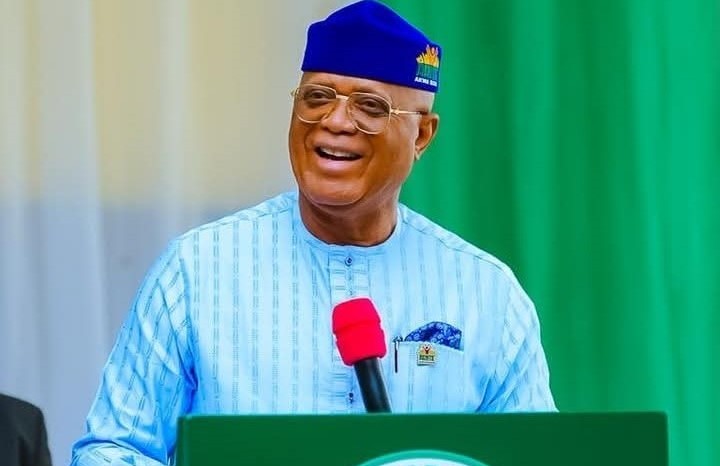
Emerging data revealed that in less than four years in office, Governor Umo Eno has paid over N100 billion out of N111 billion gratuity liabilities his administration inherited from previous administration in the state.
Commissioner, Ministry of Labour and Manpower Planning, Mr. Ikoedem Ekong, disclosed this on Tuesday in Uyo during a ministerial press briefing where he highlighted the score cards of his Ministry.
Ekong said the ministry had also resolved industrial disputes involving the Academic Staff Union of Universities, Akwa Ibom State; Judiciary Staff Union of Nigeria; National Union of Agriculture and Allied Employees; and transport-sector unions through dialogue and mediation, thus preventing disagreements from escalating.
He further disclosed that the Ministry has facilitated ₦150 million in gratuities and entitlements for former workers of Akwa Palm Limited, which had been shut for over seven years, and ₦180 million in six-month salary arrears for workers of St. Gabriel Coconut Company, Mkpat Enin Local Government Area.
In addition, he said Governor Eno subsequently approved two additional months of salary arrears for the coconut company workers beyond their initial request.
On workers’ welfare, the Commissioner said the administration has settled an outstanding 7.5 per cent contributory pension deductions for affected civil servants in the state.
Umo Eno’s administration, according to Ekong, has also introduced health insurance for public servants; paid teachers’ wardrobe allowances; and 2026 leave grants for civil servants.
Other interventions towards workers welfare include training and retraining, provision of modern working tools, brand-new sports utility vehicles for all permanent secretaries, and the integration of airport workers into the State Civil Service, with their existing salary structure retained and promotions commenced.
The Commissioner added that the ministry has continued to inspect companies and industrial establishments to enforce labour laws, local content legislation and applicable tax regulations.
He disclosed that the Ministry, in collaboration with the Nigeria Labour Congress (NLC) and Trade Union Congress (TUC), facilitated International Workers’ Day celebrations, approving ₦1.5 million each for about 70 unions in 2025 and ₦2 million each for over 80 unions in 2026.
He added that through partnership with Dakkada Skills Acquisition Centre, 310 indigenes, comprising 10 from each of the 31 local government areas, received annual skills training, while other capacity-building initiatives involved the Office of the Special Adviser on Labour-Related Matters, JEK Consult and the Michael Imoudu National Institute for Labour Studies.
On his part, the Special Adviser to the Governor on Labour Matters, Mr. Udo Kieran, said that salary adjustments had covered workers in the education and health sectors, alongside the resolution of a 12-year dispute over the Domestic Servants Allowance.
The allowance, Kieran said, was extended to university workers and teachers in line with comparable public institutions, at ₦400 monthly per beneficiary, while approved increases included 30 per cent for professors, 25 per cent for academic staff and chief lecturers at the State College of Education and Akwa Ibom State Polytechnic, and 20 per cent for non-academic staff and other eligible categories, including staff of the School of Technology.
According to him, workers in the Local Government Service also benefited from allowance increment, while doctors received 40 per cent salary increase and other medical personnel 30 per cent, as immediate health-sector interventions.
Presenting the scorecard of the Bureau of Political and Social Reorientation, the Special Adviser, Barr. Kufre Udosen, said grassroots enlightenment campaigns had reached all 31 local government areas, engaging communities, educational institutions, religious bodies and other stakeholders.
The campaigns help residents understand government policies, identify completed and ongoing projects, including roads, health centres and primary schools, and communicate community concerns to the government. Udosen cited the state’s agricultural equipment leasing initiative as an example of a programme requiring public awareness, enabling individuals to access farming equipment for commercial farming.
Udosen said the Bureau deployed billboards, newspaper publications, radio appearances and jingles to discourage social vices, misinformation, hate speech, political violence and thuggery, while promoting peaceful coexistence and democratic participation.
He gave information that political support-group membership figures exceeded 18,700 and a separate aggregate of 189,000 members across the groups, adding that performance was tracked through community reach, sensitisation activities, stakeholder engagements and citizen feedback, with support from the National Orientation Agency and relevant legislative committees.
The Bureau pledged continued collaboration with local government authorities, traditional and religious institutions, civil society organisations, community leaders, relevant agencies and the media, to strengthen informed citizenship and peaceful political participation.
Earlier, the Commissioner for Information, Mr. Aniekan Umanah, said the briefings was a platform for Ministries, Departments and Agencies (MDAs) to showcase achievements, account for their stewardship and explain government policies.
In his remarks, the Chief Press Secretary to the Governor, Mr. Ekerette Udoh, thanked journalists for their participation and urged them to sustain collaboration with the government in projecting the administration’s achievements as partners in the state’s development.
On his part, the Chairman of the Nigeria Union of Journalists (NUJ), Akwa Ibom State Council, Comrade Nsibiet John, commended the consistency of the engagement and called for the criminalisation of selling employment slots to non-indigenes by companies operating in the state, with a view to protecting qualified indigenous applicants and curb corruption.
