

By Sani Aliyu, Zaria
The Executive Director of National Agricultural Extension Research and Liaison Services (NAERLS) Prof. Sani Yusuf has said that Agricultural extension and advisory services remain a critical pillar for transforming agriculture, improving productivity, enhancing food security, and strengthening the resilience of farming communities across Africa.
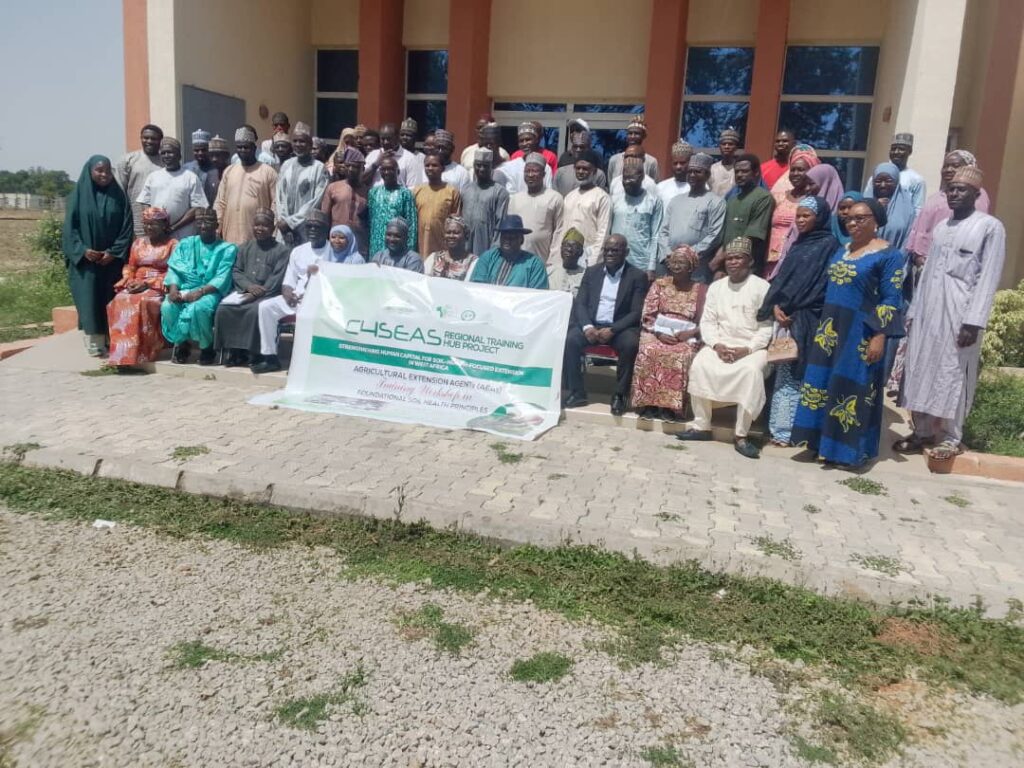
He stated this while delivering an address at the C4SEAS Training Workshop for AEAS held at the Ultra Modern Conference Hall of NAERLS/ABU Zaria.
However, the rapidly evolving challenges posed by climate change, soil degradation, emerging pests and diseases, and changing market dynamics require extension professionals to continuously update their knowledge, skills and approaches.
According to him, the workshop came at a critical time when the sustainability of agricultural production is increasingly dependent on how well we manage one of our most valuable natural resources — the soils.
Professor Yusuf said, Across Africa, soil degradation, nutrient depletion, erosion, declining organic matter, and other forms of land degradation continue to threaten agricultural productivity, food security, and the livelihoods of millions of farming households.
“These challenges are further compounded by climate variability and increasing pressure on agricultural lands,” he stated.
The Executive Director further noted that healthy soils are the foundation of productive and resilient farming systems. “They support crop growth, improve water retention, enhance nutrient cycling, and contribute to climate resilience.”
However, he continued, achieving healthy soils requires not only sound scientific knowledge but also effective extension systems capable of translating research findings into practical solutions that farmers can adopt and sustain.
“As extension and advisory service providers, you serve as the vital link between research, innovation, and farming communities.
“Your role in promoting sustainable soil management practices, supporting informed decision-making, and facilitating farmer learning is indispensable.”
He said through the training, participants will be equipped with foundational knowledge on soil health, practical tools for soil health assessment and decision-making, and effective approaches for communicating soil health information to farmers and other stakeholders.
The Executive Director acknowledged the leadership of C4SEAS and our collaborating partners for their commitment to strengthening extension systems across Africa.
“Their support demonstrates a shared vision of building a responsive, inclusive, and effective extension system capable of addressing current and future agricultural challenges.
“To all participants, I encourage you to actively engage in the sessions, share your experiences, ask questions, and make the most of the learning opportunities provided.
“The success of this workshop will depend not only on the quality of the presentations but also on the interactions, discussions, and collective learning that take place over the course of the training.
“As we officially commence this workshop, it is my expectation that the knowledge and skills acquired will be translated into practical actions that improve service delivery and ultimately enhance the livelihoods of farmers and rural communities,” he emphasized.
Giving an overview on the project, the Principal Coordinator, Professor Christogonus Daudu said, the pilot initiative is aimed at transforming Agricultural Extension and Advisory Services (AEAS) by strengthening technical capacity, developing training curricular and producing practical soil health advisory tools for extension professionals and farmers.
He said, the project’s goal is to build foundational capacity for scalable, soil health focused extension through curriculum reform, capacity building and evidence based advisory tools.
The goal aligns with the AFSH-AP contributing to the soil initiative for Africa’s target of reaching 30% of African farmers with improved soil health solutions by 2032.
The expected outcomes from the initiative are 15 certified AEAS trainers equipped with competency based soil health advisory, skills, registered in a national trainer registry.
Six validated, harmonized curriculum modules integrated into ABU degree programmes and ready for continental scaling.
