

By Mustapha Gembu
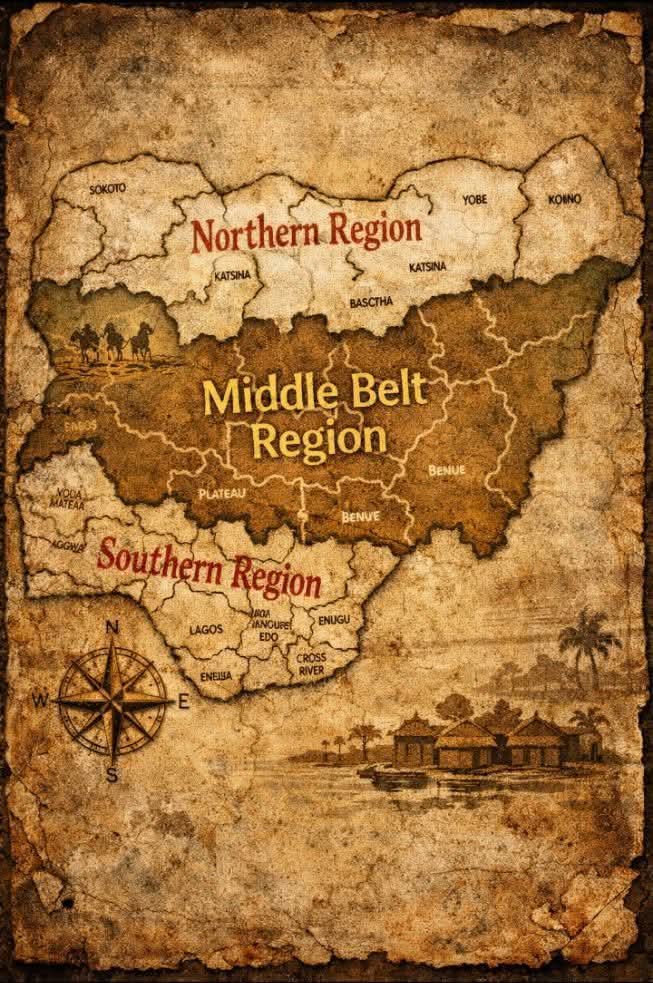
There is no such region as the Middle Belt in Nigeria. The term has no constitutional, historical, or geographical legitimacy. Rather, it is a fictional construct, sustained largely by ethno-religious bigots who seek to redefine Northern Nigerian identity through sentiment and prejudice rather than established fact. Anyone talking of a regional part of Nigeria called the Middle Belt is either an ethno-religious bigot or an illiterate, uneducated, and uninformed person.
Nigeria is officially divided into six geopolitical zones for administrative convenience: North-West, North-East, North-Central, South-West, South-East, and South-South. The so-called Middle Belt is not among them. What is often referred to by that name is simply the North-Central zone, and even that designation carries no implication of a separate historical or cultural region outside Northern Nigeria.
Historically and culturally, Northern Nigeria is made up of the North-Western region, the North-Eastern region, and the North-Central part, all of which were shaped by two dominant pre-colonial political and civilizational entities: the Sokoto Caliphate and the Kanem-Borno Empire. These two empires formed the foundation of Northern Nigeria’s political organization, cultural identity, trade systems, and religious life long before colonial rule.
To be specific, large portions of present-day Kwara, Kaduna, Nasarawa, Niger, Adamawa, Gombe, and Taraba States, along with much of the remaining Northern Nigerian territory, historically fell under the authority and influence of the Sokoto Caliphate. These areas were governed through emirates that shared common administrative systems, Islamic legal traditions, trade routes, and cultural practices.
Likewise, Borno and Yobe States were historically part of the Kanem-Borno Empire, one of Africa’s oldest and most enduring civilizations. The Kanem-Borno Empire played a central role in shaping political authority, Islamic scholarship, commerce, and cultural identity in the North-East. Together, the Sokoto Caliphate and the Kanem-Borno Empire defined the historical and cultural landscape of Northern Nigeria as a unified region.
The modern attempt to carve out a fictional Middle Belt from this historical reality is driven largely by a desire among certain groups to dissociate themselves from the Hausa-Fulani Muslim identity and the Kanuri heritage of the Borno Empire. This rejection is not rooted in history but in ethno-religious resentment, conveniently disguised as regional self-identification.
If honesty were applied, those promoting this narrative would more accurately describe their construct as a “Bible Belt Region”, since it is primarily driven by religious identity rather than geography or history. Instead, the term Middle Belt is used to conceal ethno-religious agendas beneath an invented regional label.
The inconsistency of the so-called Middle Belt further exposes its fictional nature. Depending on convenience, it is said to include southern Borno, parts of Adamawa, Gombe, and Taraba in the North-East; southern Kaduna in the North-West; and the North-Central states of Plateau, Benue, Kogi, Nasarawa, Kwara, Niger, as well as the Federal Capital Territory. This ever-shifting definition highlights the absence of clear boundaries, a definitive map, or a coherent explanation.
No authoritative historical record recognizes such a region. No fixed borders define it. Its meaning changes with political interests and religious sentiment, reinforcing the fact that it is a mirage rather than a legitimate regional identity.
Despite the attempts by ethno-religious bigots to invent the fiction of a so-called “Middle Belt region” in order to dissociate themselves from the Hausa-Fulani Muslims, the irony remains that, when combined, the areas labeled as the Middle Belt actually have a larger Muslim population than the very elements driving and promoting the narrative.
They also hate to hear the term Islamic Emirates, yet these emirates historically and culturally cover most parts of the mirage called the Middle Belt—ranging from Minna to Bida in Niger State, the Ilorin Emirate in Kwara State, and the Keffi and Lafia Emirates in Nasarawa State, Muri Emirate to Mambilla Emirate in Taraba state among others.
In conclusion, there is nothing called the Middle Belt in Nigeria. What exists is a manufactured fiction, sustained by ethno-religious bigotry and political manipulation. Historically, culturally, and geographically, Northern Nigeria remains rooted in the legacy of the Sokoto Caliphate and the Kanem-Borno Empire. If the term must be used at all, it should be honestly labeled the Bible Belt Region, not falsely presented as a distinct region of Nigeria. No matter how often the myth is repeated, fiction will never become fact.
