

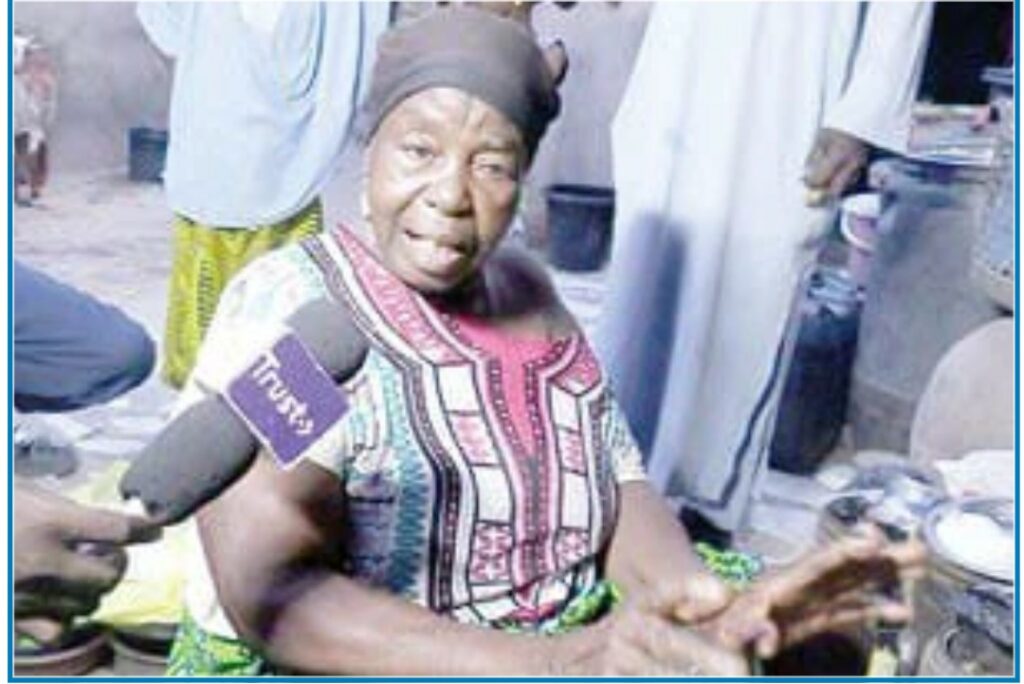
For more than five decades, Hajiya Zara Mai Tuwo wakes up to the familiar routine of grinding millet, lighting fire and preparing pots of tuwo for customers at Lungun Filasku, Fagge area of Kano metropolis.
Although she is in her 80s and age is slowing her down, it hasn’t completely taken away her attachment to the business that has sustained her family for generations.
Hajiya Zara is particularly known for her millet tuwo, served with kuka (baobab leaf) soup or okra, often accompanied by cow butter (ghee) and meat. She also became popular for a meal that is popular among northerners – Dumame. This is most times leftover tuwo or tuwo prepared at night, kept for customers and reheated in soup for consumption the following morning.
Speaking to Weekend Trust, the octogenarian recalled that she started her trading journey selling fura before switching to tuwo when her children were still young.
“This business has been on for more than 50 years. I started with fura; later, I stopped and began tuwo when my children were still young,” she said.
For Hajiya Zara, however, the business was never simply about preparing and selling food, it became the foundation upon which she raised her children, paid their school fees, married them off and provided a home for the family.
Until recently, Hajiya Zara’s working day stretched from morning until night; however, old age has limited her capacity to just evenings.
On a typical day, she said she would begin preparations around noon, grinding millet flour, setting cooking pots on fire and preparing the tuwo. Nearby, pots of soup bubble away, filling the surroundings with the aroma of meat and ghee.
By midday, her compound starts to attract customers. Young men and women, children and adults, traders, married men and widows regularly come to buy the meal, with some being long-time customers who have always patronised her tuwo for decades.
“Rain or cold weather never stops me from doing this business,” she said.
She noted that she continued working through the years because the business provided almost everything her family needed.
“With this business, I went to Mecca thrice, married off my children and bought this house, where we now live. That is why I am always happy whenever I am doing it,” she said.
‘All my schooling came from this trade’
Her children have vivid memories of growing up around their mother’s tuwo business. Datti Usman, her youngest son said he had never known his mother to be without the business.
“Since my younger years, I have known my mother with this business, and all our needs were met through it. Our father died in 1998, but all my schooling was funded by this business,” he said.
Datti, who was born in 1982, obtained a National Certificate in EDucation (NCE) from the Sa’adatu Rimi College of Education, Kano before proceeding to the Ahmadu Bello University, Zaria, where he obtained a degree. He now works in the Kano State Universal Basic Education Board (SUBEB).
Despite his government job, he assists his mother in her business whenever he returns from work.
Another son of hers, Alhaji Ado, now almost 50 years old, also noted that since he was a young boy, he had always known his mother with this business. He said he and his siblings witnessed how their mother spent decades of day and night cooking tuwo to provide for the family.
‘Why I can’t stop’
Hajiya Zara said she would not be able to stop the business despite the challenges, including the tedious tasks involved in it, explaining that stopping it also comes with its own issues.
Although her children have encouraged her to retire, she said she sometimes found it difficult to completely abandon the business.
“They told me to rest, but I can’t do that because once I rest, my body aches. That’s why I haven’t stopped,” she said.
She, however, acknowledged that old age had forced her to reduce her workload.
“In the past, I worked from morning till night, but old age has changed that. Now, I only do evenings,” she noted.
However, stopping was not an option for Hajiya Zara because at some point she tried to stop but persistent calls, requests and pressure from customers persuaded her to continue.
“Today, her five children, as well as grandchildren, help her in the business, particularly with tasks that have become difficult for her to do due to age.
Hajiya Zara, who is now a great-grandmother, has more than 60 grandchildren and over 30 great-grandchildren.
“My children and grandchildren help me a lot. I am grateful. I wish everyone well,” she said.
‘Why we patronise her’
Despite the proliferation of restaurants and food outlets across Kano, Hajiya Zara’s customers have remained loyal over the years, spanning decades. Her tuwo sells at N250 and above, depending on what the customer orders.
Most customers said that aside from her meal being readily affordable for the common man on the street, it is also tasty.
Bought at night, eaten the next day
Malam Danladi, a regular customer, said people had been eating her tuwo for decades and would miss it if she stopped preparing it.
“We buy it every day, so we will feel bad if she stops,” he said.
He explained that the Dumame associated with Hajiya Zara’s business is not necessarily prepared the following day separately. According to him, some customers buy the tuwo at night, leave it with her and come back the next morning for her to reheat in soup for them to have the next morning.
Another customer, Baba Malam, 70, noted that he had patronised Hajiya Zara’s tuwo business for more than 50 years.
He recalled that he and one of her sons used to take the tuwo to Bank to sell.
Zuwaira Muhammad, another regular customer, said familiarity and addiction to Hajiya Zara’s Dumame had made it difficult for them to stop buying.
“We are used to her tuwo; and we pray for Allah to grant the elderly woman good health and long life. Her meal is always a local delight to relish,” he said.
Recounting her early days, Hajiya Zara recalled that her business was particularly popular in the past because only a few people were engaged in selling tuwo in the area. She said some customers placed orders for dumame in advance.
“People’s desire in the past was to come to Fagge to eat this Dumame. There was a customer based in Europe who always made sure it was sent to him in Abuja whenever he was back in the country,” she noted.
Interestingly, her customers are not limited to only the Hausa-speaking tribe; the delicacy has also become popular among people of other tribes.
Her son, Datti, noted that people from different ethnic backgrounds living around Fagge also patronised his mother’s business. He said the taste and familiarity of the food had helped it survive changing times and the emergence of many modern food outlets.
However, despite the success of the business, none of Hajiya Zara’s children has fully taken it over.
“My children say it is hard work and have refused to be fully engaged in it,” she said, smiling. For her, however, the work has been worth the sacrifice, since it has kept the family going for years.
With almost 50 years of experience in the food business, Hajiya Zara believes there’s a lesson for young Nigerians searching for ways to become self-reliant. She urged young people to be patient, determined and willing to work rather than being idle and a nuisance in the society.
“I call on the youths to be calm and determined in seeking self-reliance. They should focus on business and stop idleness and fighting,” she concluded.
COURTESY: dailytrust.com
