

By Ahmed Sallam
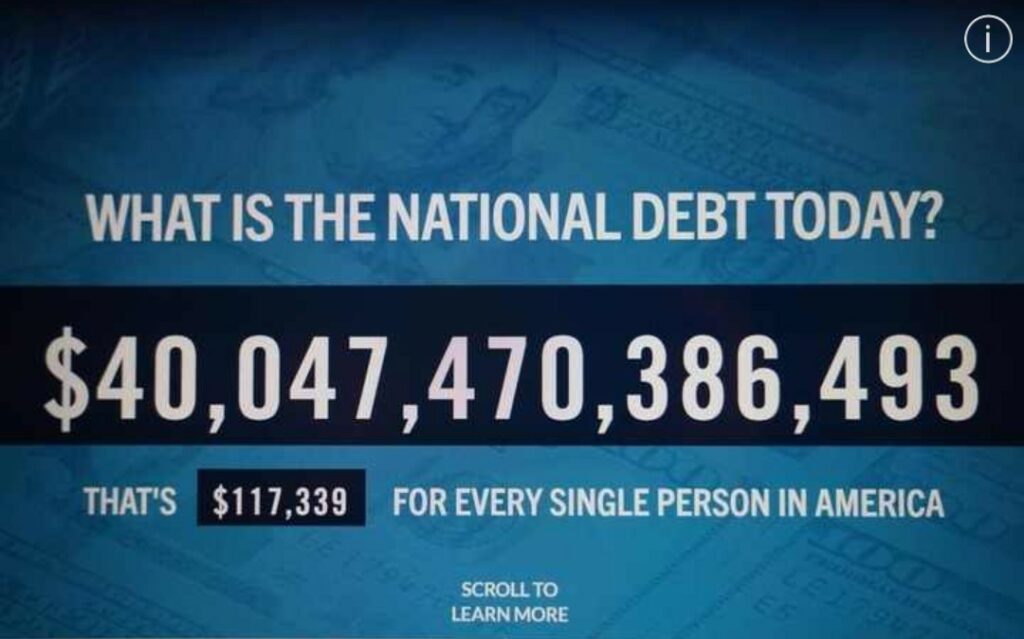
The U.S. national debt topping the 40 trillion-U.S.-dollar mark is no longer simply a staggering figure on the books of the federal government. It is increasingly a symptom of a deeper problem at the heart of the world’s largest economy.
The challenge goes well beyond the size of the debt itself, raising fundamental questions about the U.S. political system’s capacity to make difficult, long-term fiscal decisions at a time when structural deficits are widening and the cost of servicing the debt is rising at an unprecedented pace.
The significance of the figure lies not only in its sheer magnitude, but also in the fiscal dynamics behind it. The federal deficit is expected to reach approximately 1.9 trillion dollars in 2026, equivalent to 5.8 percent of GDP. The Congressional Budget Office (CBO) offers an even more troubling long-term outlook, projecting that the deficit will widen to 3.1 trillion dollars by 2036, while debt held by the public is expected to rise from about 101 percent of GDP today to 120 percent over the next decade.
This points to an increasingly difficult fiscal feedback loop: debt is no longer simply the consequence of persistent budget deficits; rising debt-servicing costs are themselves becoming a major driver of larger deficits.
The CBO expects net federal interest payments to exceed 1 trillion dollars in 2026, up from approximately 970 billion dollars in 2025, and to approach 2.1 trillion dollars by 2036. As a share of the economy, interest payments are projected to rise to 4.6 percent of GDP, from 3.3 percent today. This represents a growing drain on public resources that could otherwise be directed toward long-term investment in infrastructure, education, technology and other productive sectors.
IS THE UNITED STATES FACING IMMINENT DEFAULT?
The United States is not on the verge of being unable to meet its financial obligations in the short term. It issues the currency in which its debt is denominated and benefits from the world’s deepest and most liquid market for Treasury securities, as well as the dollar’s central role in the global financial system.
The more immediate concern, therefore, is not a technical default, but the steadily rising cost of sustaining the current fiscal trajectory in the absence of meaningful reforms.
At its core, this is as much a crisis of governance and political will as it is an economic challenge. Highly sensitive fiscal issues, including the debt ceiling, tax policy and mandatory spending programs, have increasingly become instruments of political leverage in the bitter partisan struggle between Republicans and Democrats.
Without the political willingness to pursue difficult and potentially unpopular measures — whether raising taxes or restraining federal spending — fundamental fiscal problems continue to be postponed, increasing the burden on future generations. Under current policies, debt held by the public is projected to reach 175 percent of GDP by 2056.

WHY SHOULD THE REST OF THE WORLD BE CONCERNED?
The answer lies in the dollar’s unique role in the international financial system. It is not simply the currency of the United States; it is the principal reserve currency and a cornerstone of global finance.
Data from the International Monetary Fund show that the dollar continues to account for more than 57 percent of official foreign-exchange reserves worldwide. As a result, any significant shift in U.S. borrowing costs or financial conditions can quickly reverberate across global markets through interest rates, bond yields, exchange rates and capital flows.
Emerging markets and developing economies are particularly vulnerable to these spillover effects. When yields on U.S. Treasury securities and other safe-haven assets rise, the cost of external financing for emerging economies increases. Their currencies may come under sustained depreciation pressure, while the cost of servicing dollar-denominated debt rises.
Governments already facing tight fiscal constraints may consequently be forced to divert scarce resources toward debt servicing rather than investment in infrastructure, healthcare and education.
At the same time, predictions of an imminent collapse of the dollar are largely overstated. Of course, there are undoubtedly growing international efforts to diversify foreign exchange reserves and expand the use of local currencies in bilateral trade. The more plausible scenario, therefore, is not a sudden collapse of the dollar, but a gradual transition toward a more diversified and increasingly multipolar international monetary system.
WHAT LESSONS CAN ARAB AND AFRICAN ECONOMIES DRAW?
While these developments present Washington with a serious fiscal and political test, they also offer an important lesson for Arab and African economies: economic stability cannot depend excessively on a single source of financing or on the assumption that favorable global financial conditions will persist indefinitely.
For these economies, strengthening resilience requires deeper structural reforms, including diversifying external economic and financial partnerships, expanding domestic production, boosting exports, and building stronger fiscal and financial buffers capable of absorbing external shocks stemming from higher interest rates and exchange-rate volatility.
In conclusion, the U.S. debt surpassing 40 trillion dollars is more than a record figure dominating headlines. It is a warning sign of the mounting constraints facing the fiscal management of the world’s largest economy.
If Washington continues to postpone difficult structural decisions, the consequences of political gridlock could extend well beyond U.S. borders. The global economy could ultimately bear the cost through greater financial volatility, tighter financing conditions and recurring economic shocks.
Editor’s note: Ahmed Sallam is a former undersecretary of Egypt’s State Information Service and a member of the Egyptian Council for Foreign Affairs.
The views expressed in this article are those of the author and do not necessarily reflect the positions of Xinhua News Agency.
COURTESY: Xinhua
