

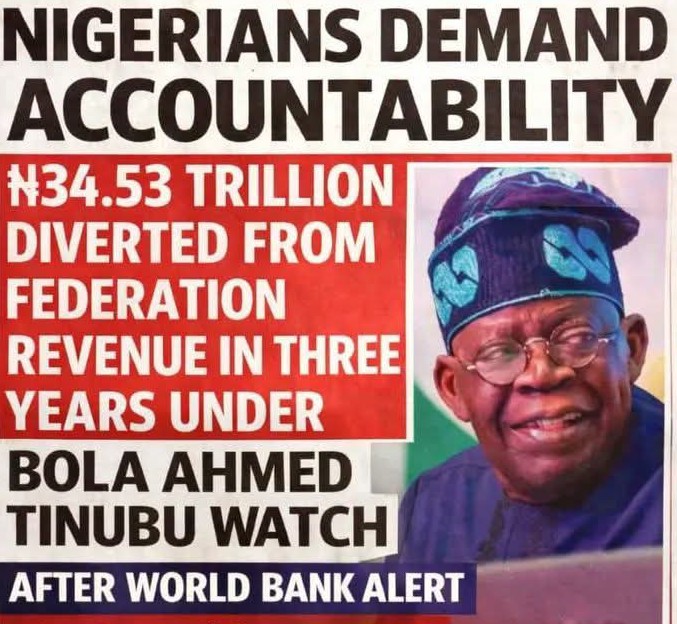
By Saidu Abubakar
The fundamental duty of a responsive government is to ensure the security and welfare of its citizens, which are the primary focal points, unless compromised by internal saboteurs, to prevent the emergence of undesirable social norms. It is evident that successive administrations have unquestionably mismanaged the two in the Nigerian context, ultimately harming the average citizen. The populace is intentionally impoverished as a diversionary tactic to serve specific interests. Nigeria’s vast endowments make it implausible to suffer such hardships.
A concerning trend in government assistance programs is the prevalence of scandal, with each administration launching code-named initiatives that are often characterized by corruption. Unfortunately, it is rare for these schemes to avoid allegations of mismanagement, with politicians, ruling party officials, and government appointees frequently accused of diverting resources for personal gain. Instances of malfeasance often go unpunished, and numerous examples have come to light. This period of pre-election rice sharing aligns with the aforementioned framework.
Life becomes unbearable without security. As it stands, the government’s seeming apathy towards providing adequate sophisticated arms to security agencies battling insurgency is not only claiming the lives of security personnel but also causing rural residents to flee their homes and abandon their farming livelihoods. The adverse effect is not in anyway secret to anyone. Villages are consistently displaced by banditry, fleeing to safer grounds on a daily basis, with Katsina, Zamfara, Borno, Yobe, Niger, Plateau, Benue, Sokoto, and Kebbi being the most impacted.
The rate at which abduction has become a lucrative business in Nigeria is alarming and with no sign of its ending any sooner. Only recently the Senate President informed that two weeks after the forthcoming elections, the banditry will stop. A comment coming from a number three citizen of the country that made everybody to develop cold feet. The abduction for ransom has gradually broadened into an unthinkable level.
Nigeria’s alarming rate of abduction has evolved into a highly profitable venture with little sign of abating. The Senate President’s recent statement suggesting a post-election cessation of banditry has understandably raised eyebrows. As the third-highest authority in the land, such a claim from this official has sparked considerable unease. Kidnapping for ransom has reached an alarming scale.
Despite Mr. President’s pre-2023 election campaign promise – “By all means necessary you must have electricity and you will not pay for estimated bills anymore, a promise made is a promise kept. If I don’t keep my promise and I come back for second term, don’t vote for me…” Perhaps Mr. President is being fed with false information about electricity because the situation remains unchanged on the heels of the Presidential Villa now being fully on solar while the situation of the national grid remains unchanged. A nation lacking stable electricity is far removed from achieving its full potential.
After a tenure spanning three years (2013-2026), the Minister of Power has stepped down from his position, necessitating a transparent assessment of his accomplishments and shortcomings. In light of substantial government allocations, notably N3.3 trillion in 2024 and another N3.3 trillion in April 2026, (all outside of the ministry budgetary allocations), the enduring unreliability of electricity supply warrants scrutiny. The nation’s persistent struggle with darkness highlights the urgent need for a revamped strategy to tackle its electricity challenges. However, this is how another minister will assume office without scrutinizing the predecessor’s actions, and starting fresh will become the strategy to phase out previous loopholes.
In the healthcare sector, it has become evident that citizens bear the responsibility for healthcare, rather than the government. Our commonwealth benefits only cater to the privileged few within government circles. Government hospitals do not provide free services to citizens. Unlike other regions, healthcare is a widespread practice, regardless of the country’s wealth. However, in Nigeria, even the aged have since come to realize that falling ill can be perilous without proper healthcare.
One inevitably reaches a point where simple yet crucial questions need to be asked: Are there genuine democrats in Nigeria’s political landscape? Who are the real beneficiaries of democratic dividends – the politicians or the Nigerian people? Will things take a turn for the better in the foreseeable future? Perhaps the comments section will be best avenue to sample opinions.
