

*Risks Stagnation if… – Atiku
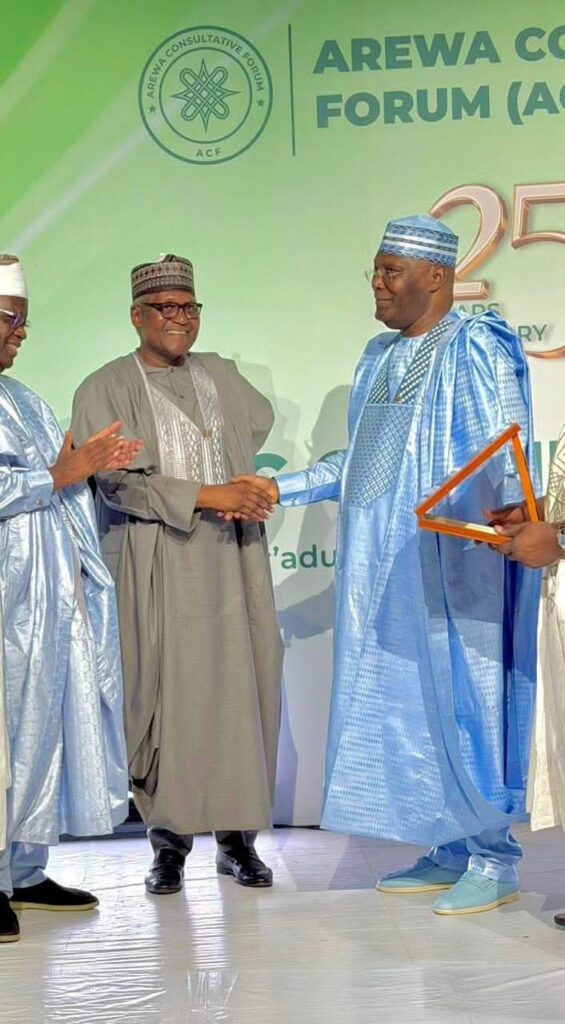
By Ado Salisu, Kano
President of the Dangote Group, Alhaji Aliko Dangote, alongside former Vice President, Atiku Abubakar, have outlined reasons for the North’s slow economic growth and worsening insecurity.
Dangote identified decades of policy inconsistency and chronic power shortages as major factors affecting the region, warning that the North risks deeper crises unless its leaders urgently reset its development path.
Speaking at the Arewa Consultative Forum (ACF) Silver Jubilee Dinner and Award Night in Kaduna on Thursday, Dangote said historical efforts to industrialise the North failed largely because government policies shifted abruptly, frustrating long-term investments and eroding investor confidence.
He recalled how, years ago, his group commissioned Arthur Andersen (now part of KPMG) to determine why several promising northern industrialists, including leading textile operators, collapsed despite their expertise and early success. The findings, he said, pointed clearly to unstable government policies.
“Imagine you are about to score a goal and someone suddenly tells you the goalpost is behind your back. That is how unpredictable government policy has been,” he said, stressing that such uncertainty crippled multiple northern industries that could have supported economic growth.
He added that the second major challenge is the persistent lack of electricity. According to him, the Dangote Group deliberately avoids connecting any of its Nigerian plants to the national grid because the supply is unreliable and insufficient for industrial-scale operations.
“The only two countries where we connect to public power are South Africa and Ethiopia. Without electricity, you cannot have growth, no matter how hard you try,” he said, noting that power shortages remain one of the biggest obstacles to reviving northern manufacturing.
Former Vice President Atiku Abubakar also warned that the North risks stagnation and deeper insecurity, unless its leaders urgently rebuild unity, reset priorities and confront the region’s growing developmental challenges with courage and vision.
Atiku said the forum’s survival through “thick and thin” over two decades shows its relevance, but insisted the North must move beyond nostalgia to honest reflection and strategic action.
He paid tributes to past ACF leaders who, according to him, “weathered enormous political and social storms” to keep the organisation alive. He prayed for the repose of their souls and urged current leaders to preserve their legacy.
Atiku recalled that when he became Vice President in 1999, the North was sharply divided along several political blocs. He said one of his earliest tasks was to bring the region under a single umbrella.
He explained how he consulted widely and set up a reconciliation committee led by the Emir of Ilorin, Ibrahim Sulu-Gambari, to unite the various northern groups into what later became the ACF.
He said the merger was challenging but ultimately successful, eventually bringing together leaders under former Head of State, General Yakubu Gowon and the late M.D. Yusufu. “Unity was our first priority,” he said.
Atiku argued that the ACF was created not just for political harmony but to drive development across the North, in line with the original vision of Sir Ahmadu Bello. He noted that Sardauna’s priorities in the 1960s — education, agriculture, and industrial growth — remain relevant.
He quoted extensively from Ahmadu Bello’s 1961 address, which emphasised agricultural expansion, soil conservation, livestock improvement, and creating the conditions for education and industry to thrive.
Atiku added that by 1999, these priorities “had acquired a new significance,” prompting him to initiate a Northern Education Project headed by Prof. Adamu Baiki to assess and revive the region’s failing education system.
