

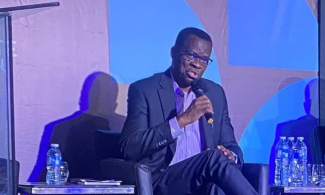
Former Independent National Electoral Commission (INEC) Resident Electoral Commissioner for Cross River and Akwa Ibom states, Barrister Mike Igini, has described Nigeria’s judiciary as “lost hope of voters”, accusing the judiciary of increasingly taking over the role of voters by determining electoral outcomes, warning that the trend poses a serious threat to democracy.
Igini spoke in Lagos on Thursday at the third edition of the Tunji Braithwaite Symposium, themed “The Judiciary and Electoral Integrity in Nigeria: Safeguarding Free, Fair, and Credible Elections for Democratic Consolidation.”
The symposium, organised in honour of the late lawyer, Tunji Braithwaite, featured a keynote address by human rights lawyer and former Chairman of the National Human Rights Commission (NHRC), Prof. Chidi Anselm Odinkalu.
Igini, who spent about 10 years working with INEC, said the judiciary, which ought to serve as the final defence of democracy and the rule of law, has in many instances become a source of concern for Nigerian voters.
He said Nigeria’s electoral system has allowed courts to assume an expanding role in deciding who becomes an elected representative, rather than ensuring that the will of voters expressed at polling units remains decisive.
According to Igini, the development has created what he described as an “expanding empire of the courts” in political matters.
“Today, in most of the cases that have gone to the courts, the judiciary that is supposed to be the last line of defence of democracy and the rule of law is today seen by the Nigerian people, the voters, as a veritable conspiracy against them,” Igini said.
“Rather than be the last hope, it is now seen as the lost hope of voters when it comes to the issue of who won the election.”
Igini said the growing judicialisation of politics was partly caused by the failure of political institutions and the electoral system to resolve disputes conclusively at the polling unit.
“The failure of politics is the reason for the expansion, the expanding empire of the courts in political matters, and the illusion that the court could help,” he said.
The former REC contrasted Nigeria’s electoral dispute system with developments in Britain, arguing that historical reforms in the United Kingdom were introduced partly because of concerns over vote-buying and the possibility of political influence over judges.
Igini said Nigeria had adopted an adversarial system in which petitioners bear the burden of proving electoral irregularities, whereas an inquisitorial approach would place greater responsibility on the electoral management body to explain how an election was conducted.
“In Nigeria, the evidential axiom that whoever has the burden of proof is what we are using here,” he said.
“And so, that is the reason why we are now having what I refer to as the expanding empire of the courts, in which case, rather than the citizen being at the centre of our democracy, in making the final decision as to who should lead, it is now judges who determine who will win elections in our country.”
Igini also criticised what he described as the increasing involvement of courts in determining which political parties and candidates participate in elections.
He recalled that the Supreme Court had, in 1979, addressed the question of whether courts should determine political questions, but argued that the judiciary now routinely finds itself handling such disputes.
“Today in our country, a court is being made to answer political questions, and they are gladly doing so,” Igini alleged.
The former electoral commissioner further criticised the interpretation of provisions governing the electronic transmission of election results.
He recalled that the 2022 Electoral Act contained provisions specifically on the live-electronic transmission of polling-unit results but noted that subsequent judicial interpretation of the law weakened the role of electronic transmission in ensuring transparency.
Igini said the introduction of the Bimodal Voter Accreditation System (BVAS) and electronic results management was intended to reduce uncertainty surrounding election results and ensure that the outcome of elections was determined at polling units.
“We developed systems, developed tools to address historical challenges with a view to ensuring that the will of the people should be determined finally and conclusively at the polling unit,” he said.
“That was why we came up with the idea of the card reader, the BVAS and, of course, the IReV, to remove the opacity about the outcome of election in polling units.”
He stressed that the judiciary should interpret electoral laws in ways that protect the sanctity of voters’ decisions rather than allowing technicalities to undermine electoral mandates.
Igini also linked the vulnerability of the judiciary to inadequate welfare and institutional support for judges.
According to him, the poor conditions under which some judges operate could expose the institution to undue influence.
“A judiciary that appears to be weak is mediated by the political class that has marginalised it,” he said.
“Today, many judges, they don’t have even orderly. They are in private homes; they rent a house in different places. They are nowhere taken care of at all, apart from the isolated cases that you see.
“So that even when we talk about judges, our reward system, it is a source of corruption in Nigeria.”
On the 2027 general elections, Igini called on Nigerians to become more actively involved in protecting the results recorded at polling units.
He specifically cited the experience of voters in Osun State, urging citizens to remain vigilant during the collation of election results.
Igini said voters should document and publicise results announced at polling units and establish mechanisms to monitor the collation process.
“I said, Osun people, stay awake for one night,” he said. “On the day of the big day, they can’t do anything. You will overwhelm them. And in the night, in the vulnerable moment, stay awake.”
Igini said the experience demonstrated that electoral laws and procedures would not automatically protect democracy without citizens and officials committed to enforcing them.
“The Osun people stayed awake for one night to secure four years,” he said. “That is what Nigeria is referring to itself.
“Because we have the law, we have the process and procedure, but they are not self-executing; they are not self-implementing. It will require men and women of integrity to be able to do so.”
Igini said Nigerians should not only turn out to vote but should also take responsibility for protecting the results produced at polling units.
“Today, we are now calling on Nigerians not only to come and vote, but we are also saying come and defend their vote,” he said. “That is how bad our situation is.”
He urged voters to “stand tall and mighty” in defence of their polling-unit results, describing the Osun experience as a possible model for strengthening citizens’ participation in the electoral process.
Igini’s comments come amid renewed debate over the role of the judiciary in Nigeria’s electoral process ahead of the 2027 general elections.
He has previously criticised provisions of the Electoral Act 2026, warning that some clauses in the Electoral Act could undermine electoral transparency and accountability.
In April 2026, Igini also argued that increasing judicial involvement in electoral matters was exposing the courts to political pressure.
The former REC has also repeatedly argued that election outcomes should be determined conclusively at polling units, with electronic transmission of results serving as an important safeguard for transparency.
COURTESY: saharareporters.com
